„Archimedes: The Genius Who Moved the World with a Lever of Thought.”
Introduction
Archimedes of Syracuse was an ancient Greek mathematician, physicist, engineer, inventor, and astronomer, who lived from 287 BC to 212 BC. Renowned as one of the greatest mathematicians of all time, Archimedes made significant contributions to the fields of geometry, calculus, and mechanics. His work laid the foundation for modern science and mathematics, particularly through his understanding of the principles of levers and buoyancy, famously illustrated by the story of his „Eureka” moment. Archimedes also invented numerous devices, including war machines and the Archimedean screw, a machine for raising water. His writings, though only partially surviving, have influenced countless scholars and continue to be studied for their profound insights into mathematics and physics.
Mathematical Contributions Of Archimedes: From Pi To Calculus
Archimedes of Syracuse, a towering figure in the annals of mathematics, made profound contributions that have resonated through the centuries, laying foundational stones for modern mathematical thought. His work, characterized by a blend of theoretical insight and practical application, has been instrumental in shaping the trajectory of mathematics. Among his many achievements, Archimedes’ exploration of the concept of pi and his anticipatory work on calculus stand out as particularly significant.
To begin with, Archimedes’ investigation into the value of pi was groundbreaking. In an era devoid of modern computational tools, he ingeniously devised a method to approximate pi with remarkable accuracy. By inscribing and circumscribing polygons around a circle, Archimedes was able to calculate the perimeters of these polygons, thereby narrowing down the possible values of pi. Through this method, he determined that pi lay between 3 1/7 and 3 10/71, a level of precision that was unprecedented at the time. This approach not only demonstrated his deep understanding of geometry but also showcased his ability to apply logical reasoning to solve complex problems.
Moreover, Archimedes’ work extended beyond geometry into the realm of what would later be known as calculus. His method of exhaustion, a precursor to integral calculus, was a technique used to determine areas and volumes of various shapes. By considering the sum of an infinite series of progressively smaller quantities, Archimedes was able to calculate the area under a curve or the volume of a solid. This method was particularly evident in his work on the quadrature of the parabola, where he successfully determined the area enclosed by a parabola and a straight line. Although the formal development of calculus would not occur until the 17th century, Archimedes’ insights laid the groundwork for future mathematicians like Newton and Leibniz.
In addition to these contributions, Archimedes’ influence extended to the field of mechanics, where his mathematical prowess was applied to practical problems. His understanding of levers and buoyancy, encapsulated in the famous Archimedes’ principle, demonstrated the application of mathematical concepts to physical phenomena. This principle, which states that a body submerged in a fluid experiences an upward force equal to the weight of the fluid displaced, is a testament to his ability to bridge the gap between abstract mathematics and tangible reality.
Furthermore, Archimedes’ legacy is not confined to his mathematical discoveries alone. His works, such as „On the Sphere and Cylinder” and „The Sand Reckoner,” have inspired generations of mathematicians and scientists. These treatises, written in a clear and methodical style, reflect his commitment to advancing human knowledge and understanding. They also highlight his innovative spirit, as he often employed thought experiments and imaginative scenarios to elucidate complex ideas.
In conclusion, Archimedes’ contributions to mathematics are both profound and enduring. His pioneering work on pi and his anticipatory steps towards calculus have left an indelible mark on the field. Through his blend of theoretical insight and practical application, Archimedes not only advanced the mathematical knowledge of his time but also laid the groundwork for future discoveries. His legacy continues to inspire and inform, underscoring the timeless nature of his genius. As we reflect on his achievements, we are reminded of the enduring power of human curiosity and the relentless pursuit of knowledge.
Archimedes And The Siege Of Syracuse
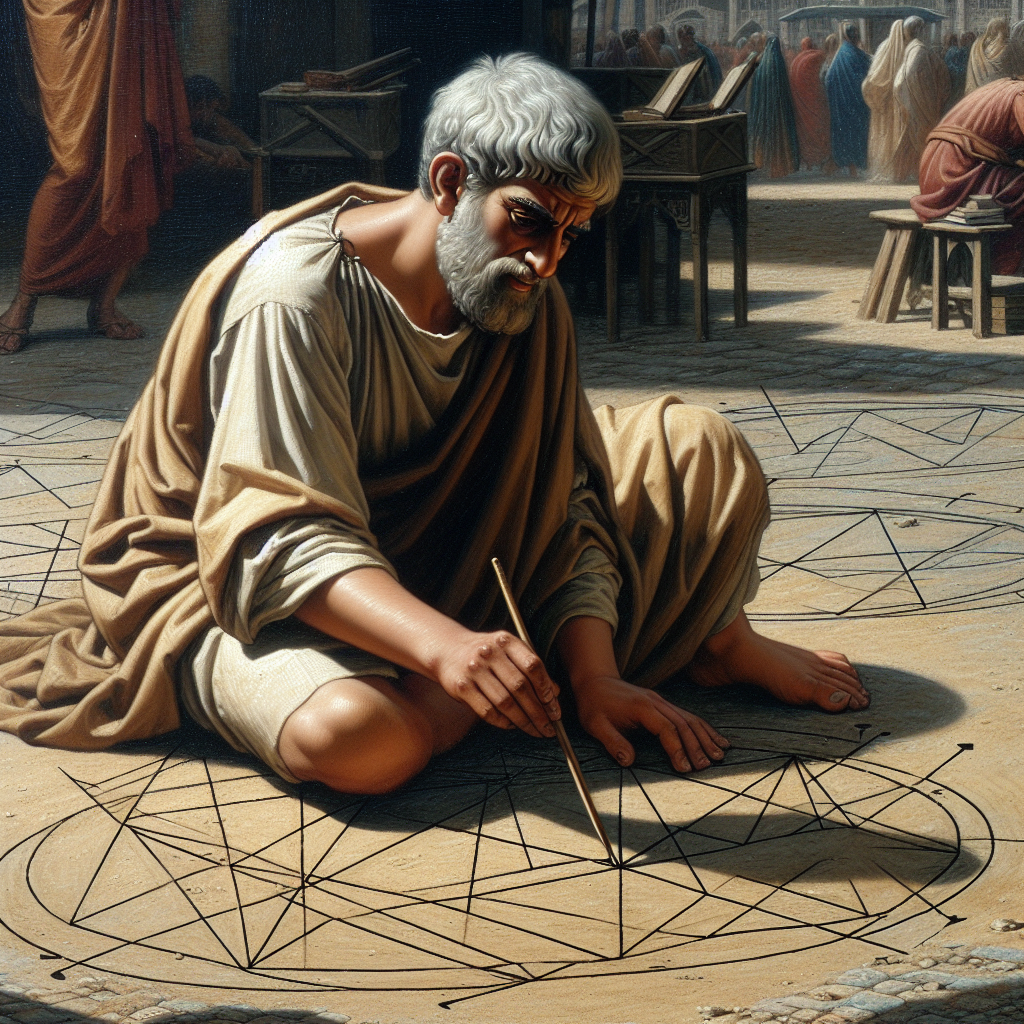
Archimedes, the renowned Greek mathematician, physicist, and engineer, played a pivotal role during the Siege of Syracuse, a significant event in the Second Punic War. This siege, which took place from 214 to 212 BC, saw the Roman Republic attempting to capture the city of Syracuse in Sicily, which was then allied with Carthage. Archimedes’ contributions during this period were not only a testament to his genius but also a demonstration of how scientific knowledge could be applied to warfare.
As the Romans laid siege to Syracuse, they were met with formidable resistance, much of which was orchestrated by Archimedes. His inventive prowess was evident in the various war machines he designed to defend the city. Among these, the most famous was the Claw of Archimedes, also known as the „Iron Hand.” This device was essentially a large crane equipped with a grappling hook. When Roman ships approached the city walls, the claw would lift them out of the water and either capsize them or drop them back with devastating force. This ingenious mechanism instilled fear in the Roman navy and significantly hindered their assault.
In addition to the Claw, Archimedes is often credited with the invention of a heat ray, although historical accounts of this device are debated. According to some sources, Archimedes used a series of mirrors to focus sunlight onto Roman ships, setting them ablaze. While modern experiments have cast doubt on the feasibility of such a device, the legend of the heat ray endures as a symbol of Archimedes’ innovative spirit.
Furthermore, Archimedes’ understanding of mathematics and physics was crucial in the development of catapults and other artillery used in the defense of Syracuse. He improved the range and accuracy of these weapons, allowing the Syracusans to strike Roman forces from a distance. His application of geometric principles to enhance the effectiveness of these machines exemplifies the intersection of theoretical knowledge and practical application.
Despite Archimedes’ remarkable contributions, the Siege of Syracuse ultimately ended in favor of the Romans. After a protracted struggle, the city fell in 212 BC due to a combination of betrayal and relentless Roman persistence. Tragically, Archimedes met his end during the sack of Syracuse. According to historical accounts, he was killed by a Roman soldier, despite orders from the Roman general Marcellus to spare his life. This loss was not only a blow to Syracuse but also to the broader world of science and mathematics.
In reflecting on Archimedes’ role during the siege, it is evident that his legacy extends far beyond his contributions to warfare. His work laid foundational principles in mathematics and physics that continue to influence these fields today. The story of Archimedes and the Siege of Syracuse serves as a reminder of the profound impact that scientific innovation can have, even in the most tumultuous of times. As we consider the historical context of his achievements, we gain a deeper appreciation for the enduring legacy of one of history’s greatest minds.
The Inventions Of Archimedes: From Claw To Screw
Archimedes of Syracuse, a towering figure in the annals of ancient science and engineering, left an indelible mark on the world through his groundbreaking inventions. His contributions, spanning various fields, have not only demonstrated the ingenuity of ancient Greek engineering but have also laid foundational principles that continue to influence modern technology. Among his most celebrated inventions are the Archimedes Claw and the Archimedes Screw, each showcasing his ability to blend theoretical knowledge with practical application.
The Archimedes Claw, also known as the „Ship Shaker,” was a formidable defensive weapon purportedly used to protect the city of Syracuse from naval attacks. This ingenious device was essentially a large crane equipped with a grappling hook. When enemy ships approached, the claw would be lowered to seize the vessel, lifting it partially out of the water and then dropping it, causing significant damage or capsizing it altogether. While historical accounts of the claw’s effectiveness vary, its conceptual brilliance underscores Archimedes’ strategic thinking and his ability to harness mechanical advantage in warfare.
Transitioning from military applications to more peaceful pursuits, the Archimedes Screw represents another of his remarkable contributions. This device, designed for raising water, consists of a helical surface surrounding a central cylindrical shaft. When the screw is rotated, water is drawn up the spiral and transported to a higher elevation. Originally developed for irrigation and drainage purposes, the Archimedes Screw has proven to be a versatile tool, finding applications in various industries even today. Its simplicity and efficiency in moving liquids and granular materials have made it a staple in agricultural and industrial settings, demonstrating the timelessness of Archimedes’ innovation.
Moreover, Archimedes’ inventions were not limited to these two devices. His work in the field of mechanics also included the development of compound pulleys and the study of levers, which he famously summarized with the statement, „Give me a place to stand, and I will move the Earth.” This profound understanding of leverage and mechanical advantage not only revolutionized the way heavy objects were moved in his time but also laid the groundwork for future advancements in engineering and physics.
In addition to his mechanical inventions, Archimedes made significant contributions to mathematics and geometry, which often informed his engineering designs. His method of exhaustion, an early form of integration, allowed him to calculate areas and volumes with remarkable precision. This mathematical prowess was instrumental in the design and functionality of his inventions, as it enabled him to optimize their efficiency and effectiveness.
Furthermore, Archimedes’ legacy extends beyond his tangible inventions. His approach to problem-solving, characterized by rigorous experimentation and a deep understanding of mathematical principles, has inspired countless generations of scientists and engineers. His ability to apply theoretical concepts to practical challenges exemplifies the synergy between science and engineering, a relationship that continues to drive innovation today.
In conclusion, the inventions of Archimedes, from the formidable Claw to the versatile Screw, highlight his extraordinary ability to merge theoretical insight with practical application. His work not only addressed the immediate needs of his time but also established principles that have endured through the centuries. As we continue to explore new frontiers in science and technology, the legacy of Archimedes serves as a testament to the enduring power of human ingenuity and the timeless relevance of his contributions.
Archimedes’ Principle: Understanding Buoyancy
Archimedes of Syracuse, a renowned Greek mathematician, physicist, engineer, and inventor, made significant contributions to various fields of science. Among his many achievements, Archimedes’ Principle stands out as a fundamental concept in fluid mechanics, providing a comprehensive understanding of buoyancy. This principle, which has been instrumental in the development of modern science and engineering, explains why objects float or sink when placed in a fluid. To fully appreciate the significance of Archimedes’ Principle, it is essential to delve into its underlying concepts and applications.
Archimedes’ Principle states that any object, wholly or partially submerged in a fluid, experiences an upward force equal to the weight of the fluid displaced by the object. This upward force is known as buoyant force, and it acts in opposition to the force of gravity. The principle can be expressed mathematically as ( F_b = rho cdot V cdot g ), where ( F_b ) is the buoyant force, ( rho ) is the density of the fluid, ( V ) is the volume of the fluid displaced, and ( g ) is the acceleration due to gravity. This equation succinctly captures the essence of buoyancy, providing a quantitative measure of the forces at play.
To illustrate the principle, consider a simple experiment involving a solid object, such as a block of wood, placed in water. As the block is submerged, it displaces a certain volume of water. According to Archimedes’ Principle, the water exerts an upward buoyant force on the block equal to the weight of the displaced water. If the weight of the block is less than the buoyant force, the block will float; if it is greater, the block will sink. This fundamental understanding of buoyancy has profound implications for various scientific and engineering applications.
In the realm of shipbuilding, Archimedes’ Principle is crucial for designing vessels that can float and remain stable in water. By calculating the buoyant force and ensuring it exceeds the weight of the ship, engineers can design hulls that displace enough water to support the vessel’s weight. This principle also aids in determining the load capacity of ships, ensuring they can safely carry cargo without the risk of sinking. Furthermore, submarines utilize this principle to control their buoyancy, allowing them to submerge and resurface by adjusting their displacement through ballast tanks.
Beyond maritime applications, Archimedes’ Principle is instrumental in various scientific fields. In the study of fluid dynamics, it helps explain the behavior of gases and liquids under different conditions. Meteorologists, for instance, use the principle to understand atmospheric phenomena, such as the formation of clouds and the movement of air masses. Additionally, in the field of medicine, the principle is applied in designing devices like hydrometers, which measure the density of liquids, and in understanding the buoyancy of human bodies in water, which is essential for developing life-saving flotation devices.
In conclusion, Archimedes’ Principle provides a foundational understanding of buoyancy, elucidating the forces that determine whether an object will float or sink in a fluid. Its applications span a wide range of disciplines, from shipbuilding and fluid dynamics to meteorology and medicine. By offering a clear and concise explanation of buoyant forces, Archimedes’ Principle continues to be a cornerstone of scientific inquiry and engineering design, underscoring the enduring legacy of Archimedes’ contributions to the world of science.
The Life And Legacy Of Archimedes
Archimedes, a towering figure in the annals of ancient science and mathematics, was born in 287 BC in the bustling city of Syracuse, located on the island of Sicily. His life and work have left an indelible mark on the fields of mathematics, physics, engineering, and astronomy. As we delve into the life and legacy of Archimedes, it is essential to understand the context in which he lived and the profound impact of his discoveries on subsequent generations.
Archimedes was born into a world where Greek culture and knowledge were flourishing. His father, Phidias, was an astronomer, which likely influenced Archimedes’ early interest in the sciences. Although much of his early life remains shrouded in mystery, it is widely believed that Archimedes studied in Alexandria, Egypt, a hub of learning and intellectual exchange during that era. This exposure to the rich intellectual environment of Alexandria undoubtedly shaped his future contributions to science and mathematics.
One of Archimedes’ most significant contributions was his work in geometry. He is credited with discovering the relationship between the surface area and volume of a sphere and its circumscribing cylinder. This discovery was so important to him that he requested it be engraved on his tombstone. Furthermore, Archimedes made substantial advancements in understanding the principles of levers and pulleys, famously stating, „Give me a place to stand, and I shall move the Earth.” This statement encapsulates his profound understanding of mechanical advantage, which laid the groundwork for future developments in engineering and physics.
In addition to his theoretical work, Archimedes was also a prolific inventor. His inventions, such as the Archimedean screw, a device for raising water, and various war machines, including the Claw of Archimedes, demonstrate his ability to apply theoretical principles to practical problems. These inventions not only served immediate practical purposes but also inspired future generations of engineers and inventors.
Moreover, Archimedes’ contributions to mathematics extended beyond geometry. He made significant strides in the field of calculus, long before it was formally developed by Newton and Leibniz. His method of exhaustion, a precursor to integral calculus, allowed him to calculate areas and volumes with remarkable precision. This method demonstrated his ability to think abstractly and laid the foundation for future mathematical discoveries.
Despite his numerous achievements, Archimedes’ life was not without challenges. During the Second Punic War, Syracuse was besieged by Roman forces. Archimedes played a crucial role in the city’s defense, using his inventions to repel the invaders. However, in 212 BC, Syracuse fell to the Romans, and Archimedes met his untimely death at the hands of a Roman soldier. His death marked the end of an era, but his legacy continued to influence the world for centuries to come.
In conclusion, Archimedes’ life and work exemplify the power of human curiosity and ingenuity. His contributions to mathematics, physics, and engineering have had a lasting impact on the development of these fields. Through his discoveries and inventions, Archimedes not only advanced the knowledge of his time but also laid the groundwork for future scientific and mathematical breakthroughs. His legacy serves as a testament to the enduring power of intellectual pursuit and the profound impact one individual can have on the course of history.
Conclusion
Archimedes of Syracuse was a preeminent ancient Greek mathematician, physicist, engineer, inventor, and astronomer, whose contributions laid foundational stones for various scientific fields. Renowned for his work in geometry, he formulated principles such as the Archimedes’ Principle in fluid mechanics and devised methods to calculate areas and volumes of shapes, which prefigured integral calculus. His inventions, including the Archimedean screw and war machines, demonstrated his prowess in applied science. Archimedes’ blend of theoretical insight and practical application not only advanced the knowledge of his time but also influenced countless generations of scientists and mathematicians, cementing his legacy as one of history’s greatest scientific minds.